Hosting the World: Cuba, Café Cubano, and the Lessons of Olimpia’s Table
By Emilia Kim
Welcome back to Hosting the World™!
Some episodes in this series start with research. This one started at a kitchen table in Puerto Rico, a long time ago, with a pencil in my hand, a math problem I did not understand, and a tiny cup of coffee sitting next to my notebook.

I grew up in Puerto Rico, and I will be honest with you: I was very bad at math. So bad that my family decided I needed help, and they took me to a Cuban lady named Olimpia. She was from Matanzas, Cuba, and she taught math lessons out of her home. I thought I was going there to learn fractions. I did not know I was also going there to learn about a whole country.
This week, I am hosting Cuba. And the table I built for this episode is not just a Cuban table. It is my attempt to recreate Olimpia’s table, the one where I learned math, fell in love with coffee, and first tasted the dish that would become my favorite Cuban food of all time.
Cafecito Cubano: Meant to Be Shared
Every country in this series has a word or an idea at its heart. For South Africa it was Ubuntu. For the Philippines it was Bayanihan. For Syria it was Karam. For Cuba, I definitely knew the answer: café cubano!
Cuban coffee often begins with the familiar sound of a moka pot on the stove and the smell of strong coffee filling the kitchen. When you hear the moka pot begin to bubble, you know it is ready. The first drops are whipped with sugar into espumita, then poured into tiny tacitas and shared. For many Cubans, it is a ritual tied to home, family, conversation, and memories. A little cup that carries much more than coffee.
That is exactly what Olimpia’s table felt like. Nobody sat at it alone. There was always coffee, always something sweet on a plate, always a story waiting between one math problem and the next. And it was at that table that she handed me my very first cup of coffee.
I still remember it. The cup was small, the coffee was dark, and the rim had to be thin. She always said Cuban coffee just didn’t taste the same from a thick-rimmed cup. And there was the pale, sugary foam! I took a sip, and something in me just clicked. I fell in love with coffee right then and there, and I have never fallen out of love since. Every cup I drink today carries a little bit of that afternoon in it. Now, I have around 4 cups daily.
Olimpia and the Pride of a Cuban Education
Olimpia talked about a lot of things while I worked through my math problems, but she especially loved talking about her education. She was incredibly proud of it. She would always tell me how important it was to learn and to have an education, because knowledge was something no one could ever take away from you. Back then, I was a teenager who mostly just wanted to get through my math worksheet. I don’t think I realized how much of what she was telling me would stay with me all these years later.
Planting Trees Behind the School
She told me that when she was a student, she and her classmates used to plant trees in the back of the school. She described it so vividly: kids with dirt on their hands, rows of little saplings, the feeling of taking care of something that would grow long after they were gone. In Cuba, schoolwork and outdoor work often went hand in hand, and many schools combined classroom study with time spent working the land. For Olimpia, it was not a chore. It was one of her happiest memories.
Being “Becados”
She also told me that most of the time, kids were “becados,” which meant they lived at the school as boarding students. The word comes from beca, which means scholarship. You studied there, you ate there, you slept there, and your classmates became something like family. I remember being shocked by this as a kid in Puerto Rico. Living at school? Away from home? But Olimpia spoke about it with so much warmth. She said she really enjoyed that experience, the friendships, the routine, the feeling of growing up together.
Olimpia’s memories of Cuba were not all simple or nostalgic. There were parts of life there she did not remember fondly, and she was honest with me about those too. But when she talked about her school years, there was a warmth that was impossible to miss. Those were the stories that made her smile: the classrooms, the trees they planted, the friends she grew up alongside, and the books she loved.

El Conde de Montecristo
Speaking of books. Olimpia’s favorite, by far, was El Conde de Montecristo, Alexandre Dumas’s The Count of Monte Cristo. She was completely obsessed with it. She told me she could not stop reading it, that she would read late into the night, turning pages to find out what Edmond Dantès would do next.
What I did not know back then is how deeply that book is woven into Cuban culture. In Cuban cigar factories, there was a long tradition of the lector, a person who read aloud to the workers as they rolled tobacco by hand. Newspapers, poetry, and novels filled those rooms for hours every day. The Count of Monte Cristo became such a beloved favorite among the workers that one of Cuba’s most famous cigar brands, Montecristo, was named after it.
So when Olimpia told me she could not put that book down, she was part of something much larger than herself. Generations of Cubans had fallen under the same spell. I love that.
The Math That Came Full Circle
Here is the part of the story that still gets me. Olimpia taught me math so well, so patiently, that the girl who was once “very bad at math” ended up teaching math to students in college. I do not think I would have ever stood in front of a classroom if it were not for those afternoons at her table. She gave me coffee, she gave me Cuban food, and she gave me confidence. That last one might have been the most valuable gift of all.
Matanzas: The Athens of Cuba
It makes perfect sense to me now that Olimpia was from Matanzas. The city, on Cuba’s northern coast east of Havana, has long been nicknamed “La Atenas de Cuba,” the Athens of Cuba, because of its rich history of poets, writers, musicians, and intellectual life in the 19th century. It is also known as the City of Bridges for the many bridges that cross its rivers.
Matanzas is also a city of music. It is widely credited as the birthplace of the danzón, considered Cuba’s national dance, and it is a deep root of Afro-Cuban rumba. A city that treasured poetry, music, and learning raised a woman who treasured all three. Of course she was proud of her education. It was in the air she grew up breathing.
A Crossroads Cuisine
Before we get to the menu, a little context on what makes Cuban food taste the way it does. Cuban cuisine is a beautiful blend of many worlds:
- Taíno roots: The Indigenous people of the island cultivated yuca (cassava), which is still central to the Cuban table today.
- Spanish influence: From Spain came the sofrito base of onion, garlic, and peppers, hearty bean and legume stews called potajes, custards, and rice dishes descended from Spanish traditions.
- West African influence: Enslaved Africans brought cooking techniques, flavors, and a deep culinary knowledge that shaped dishes built on beans, rice, root vegetables, and plantains.
- Caribbean neighbors: Cuba shares so much with the rest of the Caribbean, including Puerto Rico. Sitting at Olimpia’s table, I recognized a lot, the sofrito, the guava, the love of rice and beans, and yet everything had its own distinctly Cuban accent.
That familiarity is part of why her table felt like home to me. Cuba and Puerto Rico have long been called two wings of the same bird, and I tasted that in every bite.
The Menu: Recreating Olimpia’s Table
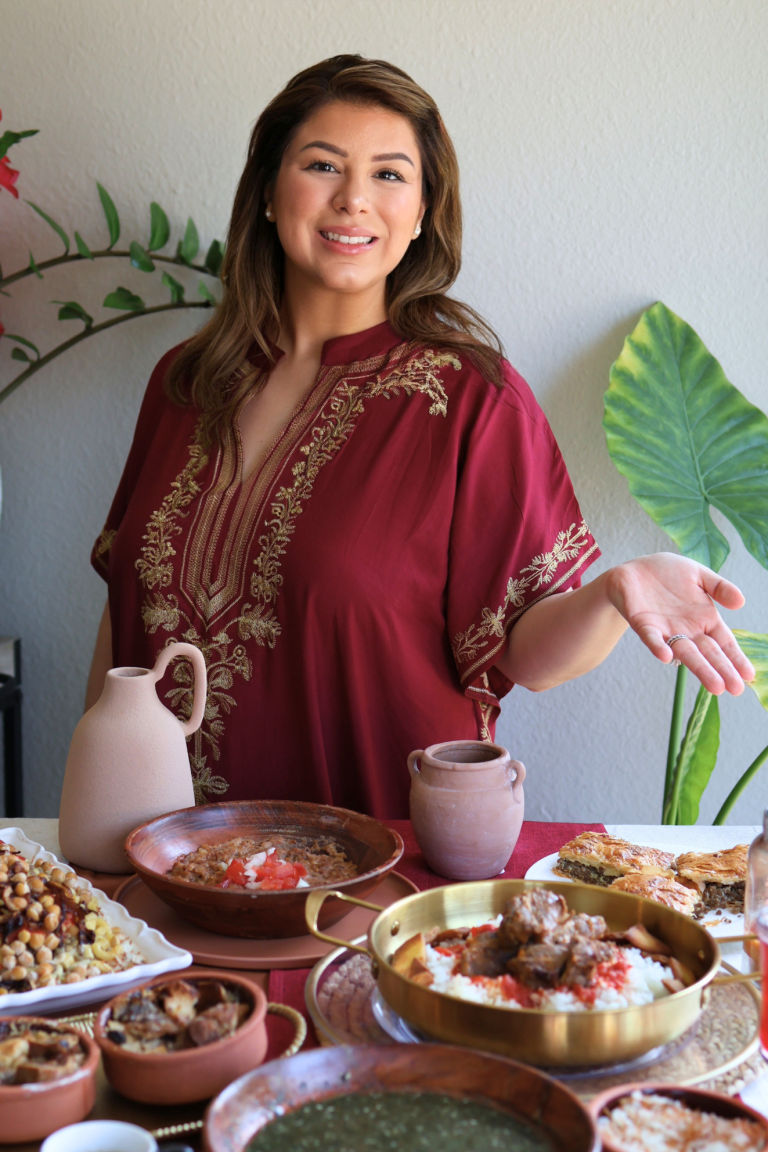
For this episode, I built a menu to represent Olimpia’s table: the kinds of dishes she talked about, the kinds of flavors she shared with me, and of course, my favorite of them all.
To Start: Pastelitos de Guayaba
Pastelitos de guayaba are flaky puff pastry turnovers filled with sweet guava paste. In Cuban communities, they are everywhere: bakeries, breakfast counters, birthday parties, office meetings. They are the pastry you pick up by the dozen. And they are the perfect partner for a coffee, which is exactly how I like them.

The Comfort Pot: Potaje de Chícharos
Potaje de chícharos is a thick, cozy split pea stew. It is usually simmered with sofrito, potatoes, and calabaza (Caribbean squash), and often flavored with ham or chorizo. It is the kind of dish that tastes like a weekday dinner made with love, simple, filling, and warm. Potajes are a whole category of Cuban home cooking, and this one is a classic.
My Favorite: Arroz Imperial
And now, the dish that started it all. Arroz imperial is, to this day, my favorite Cuban dish, and Olimpia is the one who introduced me to it.
Arroz imperial is a layered rice casserole. It starts with arroz amarillo con pollo, yellow rice cooked with seasoned shredded chicken. That rice is layered in a baking dish with a creamy layer of mayonnaise and a generous blanket of cheese, then baked until the top is golden and bubbling. It is rich, it is comforting, and it is the ultimate party dish, the one you bring to a family gathering and watch disappear.
I remember the first time I tried it. I could not believe rice could taste like that. Making it for this episode felt like visiting her again.

The Main Event: Congrí with Ropa Vieja
Congrí is rice and beans cooked together in one pot, so the rice soaks up all of the flavor and color of the beans and their seasoning. You will sometimes hear the names congrí and moros y cristianos used for similar dishes depending on the region and the family. In eastern Cuba, congrí is traditionally made with red beans, while black bean versions are common across much of the island.
Alongside it, I served ropa vieja, arguably Cuba’s national dish. Ropa vieja means “old clothes,” because the shredded flank steak, simmered low and slow in a tomato sofrito with peppers and onions, looks a bit like a pile of colorful rags. The dish has roots in Spain and the Canary Islands, but Cuba made it its own. It is tender, saucy, and perfect over rice.

The Side: Yuca al Mojo
Yuca al mojo is boiled yuca, soft and a little bit starchy, drenched in mojo, a garlicky citrus sauce made with sour orange juice, olive oil, and plenty of garlic, often with thinly sliced onions softened in the warm oil. It is bright, punchy, and addictive. It is also a direct line back to the Taíno roots of the island.

Something Sweet: Natilla Cubana
Natilla cubana is a silky, spoonable custard, usually perfumed with cinnamon and a strip of lemon or lime peel, and finished with a dusting of ground cinnamon on top. It is the dessert of Cuban grandmothers everywhere, simple and soothing.
Another Sweet: Casquitos de Guayaba
Casquitos de guayaba are guava shells poached in a sweet syrup until tender and glossy. They are traditionally served with a slice of queso blanco on the side, and that sweet and salty contrast is everything. Guava appears twice on this menu on purpose. It is one of the flavors I associate most with Olimpia’s kitchen.
To Drink: Café Cubano
Of course, this table would not be complete without café cubano. It is a strong espresso-style coffee sweetened as it brews. The secret is the espumita: you take the very first few drops of coffee and whip them vigorously with sugar until they become a thick, pale paste, then pour the rest of the coffee over it. That creates the light foam that sits on top of every proper cup.
This was the cup that started my love affair with coffee. Making it for this episode felt a little like coming home.

And Finally: Batido de Mamey
To finish, a batido de mamey, a creamy milkshake made with mamey, a tropical fruit with salmon-colored flesh and a flavor somewhere between sweet potato, pumpkin, and apricot. Blended with milk, a little sugar, and ice, it is thick, sweet, and deeply tropical. If you have never tried mamey, this is the way to start.
Sourcing Cuban Ingredients in the US
Good news: most of this menu is very approachable. Here are a few tips:
- Guava paste and guava shells: Look in the Latin or international aisle of larger grocery stores, or at any Latin market. Guava shells usually come canned in syrup.
- Yuca: Fresh yuca is often in the produce section, but frozen peeled yuca is a huge time saver and works beautifully. I always use frozen!
- Mamey: Fresh mamey can be hard to find, but frozen mamey pulp is often sold in the freezer section of Latin grocery stores.
- Cuban coffee: Look for dark roast espresso-style coffee ground for a stovetop moka pot, which is how many Cuban households brew it.
Frequently Asked Questions
What is arroz imperial?
Arroz imperial is a Cuban baked rice casserole made from layers of yellow rice with chicken, mayonnaise, and cheese. It is a popular dish for parties and family gatherings.
Why is ropa vieja called “old clothes”?
The name comes from the dish’s appearance. The shredded beef simmered with colorful peppers and onions resembles a pile of old, torn clothing.
What does “becado” mean in Cuba?
“Becado” comes from the Spanish word beca, meaning scholarship. It describes a student who lives at a boarding school, where housing and meals are part of the arrangement.
What is the connection between Cuba and The Count of Monte Cristo?
The novel was a favorite of Cuban cigar factory workers, who listened to it read aloud by lectores as they rolled tobacco. The famous Montecristo cigar brand takes its name from the book.
What does mamey taste like?
Mamey has a sweet, creamy flavor often compared to a mix of sweet potato, pumpkin, and apricot, with hints of almond.
Final Thoughts
I did not know it at the time, but those afternoons at Olimpia’s table were some of the most important of my life. I went there to learn math. I left with a love of coffee, a favorite dish, a window into a country I had never visited, and the confidence to one day stand in front of my own students.
That is the thing about a table. It is never just about the food. It is about who sits with you, what they share, and what they leave you with. Olimpia shared her coffee, her arroz imperial, her memories of planting trees and living at school, and her love for a book about a man who never gave up. And she shared her belief that what you learn stays with you forever.
She was right. It did.
So this episode of Hosting the World is for Olimpia. Pour a colada, pass the tacitas around, and make room at the table for whoever happens to walk in. That is how she would have wanted it.
Gracias, Olimpia. Hasta la próxima, friends.