
Fattet Makdous: A Delicious Syrian Layered Dish Featuring Eggplants
By Emilia
If you have been following along with my Hosting the World series, you already know Syria’s table is one of the most generous I have ever written about. Today I am going deeper into one specific dish from that segment, fattet makdous, a layered plate of crispy pita, tangy tahini yogurt, tomato broth, and small eggplants stuffed with warmly spiced ground beef. It is comfort food and showpiece at the same time, and once you understand how it fits into the much bigger world of fatteh, you will see why it took me longer to get this one right!

Karam, the Idea Behind the Dish
In my main Syria post, I spent a lot of time on the word karam, the Bedouin-rooted idea of hospitality built on over-providing for a guest. Karam is not just about having enough food on the table. It is about having more than enough, food that keeps arriving after you have already said you are full, because a host who stops too soon has somehow failed their guest.
Fattet makdous is a perfect example of karam in practice. It is a dish built in layers, quite literally, and every layer is its own small act of generosity. Crispy pita to soak up sauce. A tangy, garlicky tahini yogurt. A rich tomato and beef broth. Tender stuffed eggplants on top. Toasted pine nuts and parsley to finish. No single component is doing all the work. It is a dish that keeps giving, course after course, bite after bite, which is very on brand for how Syrians host.

Fatteh Is Not One Dish, It Is a Whole Family of Dishes
Here is where things get interesting, and honestly where I got a little lost during my research. Fatteh is not a single recipe. It is a category, a technique, almost a philosophy of using stale or fried bread as the base for a layered dish, then building something rich and saucy on top of it. Once I understood that, the sheer number of versions out there made a lot more sense.
Egypt has its own version, usually called fatta, most famously served at big celebrations like Eid al-Adha. Egyptian fatta typically leans on rice, garlicky vinegar-spiked broth, and pieces of meat, and it shows up at moments that call for abundance, weddings, holidays, and family gatherings where the host wants to make a statement.
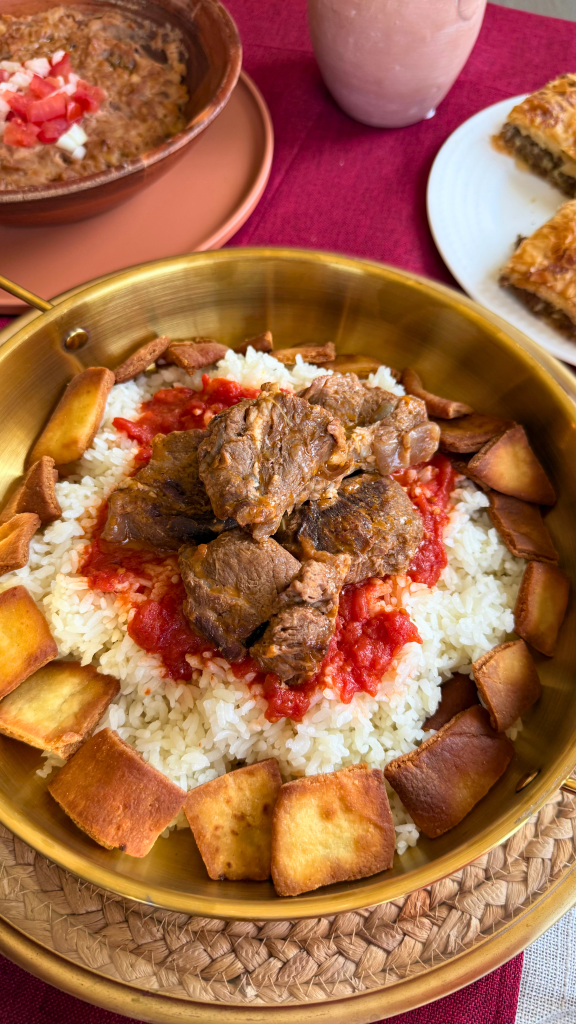
Palestine has its own fatteh traditions as well, and Palestinian fatteh dishes vary widely by region and even by family, sometimes built with chickpeas and yogurt, sometimes with meat, sometimes served for breakfast rather than dinner. The through line across every country is the same, though. Bread on the bottom, something saucy and rich layered on top, and a dish that is meant to be shared generously.
Then you get to Syria, and Syria alone has a whole universe of fatteh dishes. There is fatteh made with chickpeas and no meat at all. There is fatteh built around lamb. There is fatteh served warm for breakfast in some households and reserved for special occasions in others. And within that universe, you land on today’s dish, fattet makdous, which swaps the usual chickpeas or shredded meat for small stuffed eggplants.
Even Within Syria, Fattet Makdous Has Its Own Family Tree
What surprised me most while researching this dish is that fattet makdous is not even one fixed recipe within Syria. There is a version most closely associated with Damascus, and that Damascene version alone has several sub-variations depending on who is making it. Some Damascus households make the eggplants meat-stuffed, as I did here. Others keep the filling vegetarian, built from rice, herbs, and warm spices instead of beef. Some cooks fry the eggplants before stuffing them, others roast them, and some skip the frying step entirely and simmer everything straight in the tomato broth from the start. Some chop the eggplants into small cubes and then fry it. There are so many varieties!!!
Why It Is Fatteh, but Fattet Makdous
This part took me embarrassingly long to figure out, so let me save you the trouble. In Arabic, fatteh is the standalone word for the dish, or more precisely for the technique of building a layered bread dish. But Arabic nouns change form when they are directly connected to a second noun that describes or specifies them, a grammatical structure called the idafa, or possessive construction. When that happens, the soft “h” sound at the end of a feminine noun like fatteh shifts to a hard “t” sound, so fatteh becomes fattet when it is followed by whatever it is being made with or paired with.
That is exactly what is happening with fattet makdous. You are not naming two separate things, “fatteh” and “makdous,” side by side. You are naming one specific dish, “the fatteh of makdous,” and Arabic grammar automatically shifts that ending sound to mark the connection. You will see the same pattern across other fatteh dishes too, fattet hummus, fattet djaj (chicken), fattet lahmeh (meat). The base word changes its ending depending on what follows it, even though it is always fundamentally the same dish family underneath.
Small detail, I know, but once someone explained it to me, it made the whole language click a little more, and I wanted to pass that along in case it helps you the way it helped me.
Assembling Everything
I stuffed small baby eggplants with a mix of ground beef, finely diced onion, allspice, cinnamon, and black pepper, then browned them before letting them simmer low and slow in a garlicky tomato broth built with beef stock and a spoonful of tomato paste for depth. While that was going, I whisked together plain whole-milk yogurt with tahini, grated garlic, and fresh lemon juice, starting with a smaller amount of tahini and tasting as I went since it can overpower the yogurt quickly if you are not careful.
For the base, I fried two large pitas in oil until they were properly crisp, since a soggy base defeats the entire purpose of this dish. I spread the tahini yogurt over the crispy pita first, then spooned the stuffed eggplants and their tomato broth generously over the top, finishing everything with toasted pine nuts, a scatter of fresh parsley, and a drizzle of good olive oil right before serving.
One thing I would tell any first-timer: build this dish right before you serve it, and serve it immediately. Fatteh dishes in general do not hold well. The crispy base is the whole point, and it turns soft fast once the sauce and yogurt hit it. This is a dish meant to be eaten the moment it is set on the table, which honestly fits the spirit of karam perfectly. It is generous, but it does not wait around.
Note: Baby eggplants can often be found at Middle Eastern or Mediterranean grocery stores. I found mine at Sara’s Market in Richardson, Texas. Look for small, firm eggplants that are similar in size so they cook evenly and are easy to stuff.

Frequently Asked Questions
What does “fatteh” actually mean?
Fatteh comes from an Arabic root related to breaking or crumbling bread, and it refers to the technique of using bread as a base layer under a saucy, layered dish rather than to one specific recipe.
Why is it called fattet makdous instead of fatteh makdous?
Because in Arabic grammar, some nouns like fatteh shift their ending sound when they are directly linked to a second noun in a possessive construction. Fattet makdous literally translates to something like “the fatteh of makdous.”
Is fattet makdous the same in every Syrian household?
Not at all. Even within Damascus, where this version is most closely associated, families vary the filling, whether the eggplants are fried or roasted first, and how the tahini yogurt is layered or mixed in.
Can I make this vegetarian?
Yes. Many Damascus households make a meat-free version using a rice and herb filling in place of the ground beef, and the tomato broth and tahini yogurt work just as well either way.
Can I prepare parts of this ahead of time?
You can stuff and braise the eggplants and mix the tahini yogurt sauce ahead of time and refrigerate them separately. Fry the pita and assemble the full dish only right before serving so the base stays crisp.
Final Thoughts
Fattet makdous rewards patience twice over, once in the kitchen and once in the research. What looks like a single recipe online is actually the tail end of a much longer story, one that stretches from Egyptian fatta to Palestinian fatteh traditions to a whole tree of variations inside Syria alone, then narrows down to the specific choices one Damascus household makes on any given day. I love that about this series. The deeper I dig, the more I realize how much room there is for a dish to still be “correct” while looking completely different from house to house.
If you have not already, click here to read the full Hosting the World: Syria post, where I cover the rest of the Syrian table, from muhammara and kishkeh to the Damascus and Aleppo culinary rivalry, and where karam shows up again and again as the thread that ties it all together.

Fattet Makdous

Ingredients
For the stuffed eggplants
- 5 small baby eggplants
- oil for frying
- 8 oz ground beef (225 g)
- 1/2 small onion finely diced
- 1/2 tsp ground allspice
- 1/4 tsp ground cinnamon
- 1/4 tsp black pepper
- salt to taste
For the tomato broth
- 1 tbsp olive oil
- 2 garlic cloves minced
- 1 can tomato sauce (14–15 oz / 400 g)
- 1 cup beef broth
- 1 tbsp tomato paste
- salt & pepper to taste
For the tahini yogurt sauce
- 2 cups plain whole-milk yogurt
- 1/3 cup tahini try with 1/4 cup first and taste
- 1 garlic clove grated
- 1-2 tbsp fresh lemon juice
- 1/2 tsp salt or more to taste
For the pita
- 2 large pitas
- oil for frying
For garnish
- 2-3 tbsp toasted pine nuts
- fresh parsley chopped
- olive oil to drizzle
Instructions
Prepare the eggplants
- Wash and dry the baby eggplants, leaving the stems intact.
- Carefully hollow out the center of each eggplant from the top, removing enough flesh to create space for the filling without piercing the sides or bottom.
- Heat a shallow layer of oil in a skillet over medium heat. Fry the eggplants, turning occasionally, until lightly browned and beginning to soften. Transfer to a paper towel-lined plate and set aside.
Make the beef filling
- Add the diced onion to a skillet and cook over medium heat until softened. Add the ground beef and cook until browned, breaking it into small pieces as it cooks.
- Season with the allspice, cinnamon, black pepper, and salt. Stir in the pine nuts and cook for another minute. Remove from the heat and allow the filling to cool slightly.
- Carefully spoon the beef mixture into the hollowed eggplants, filling each one generously.
Make the tomato broth
- Heat 1 tablespoon olive oil in a large skillet or shallow saucepan over medium heat. Add the garlic and cook briefly until fragrant.
- Add the crushed tomatoes, beef broth, and tomato paste. Season with salt and black pepper. Stir well and bring to a gentle simmer.
Simmer the stuffed eggplants
- Carefully place the five stuffed eggplants into the tomato broth.Cover partially and simmer gently for 15–20 minutes, turning or spooning some of the sauce over them as needed, until the eggplants are completely tender and have absorbed some of the flavor of the tomato broth.
- Carefully remove the eggplants and set them aside. Do not discard the tomato broth, as you will use it to assemble the fatteh.
Prepare the tahini yogurt
- In a bowl, combine the yogurt, tahini, garlic, lemon juice, and salt. Whisk until completely smooth and creamy. (The yogurt should be the dominant ingredient, with the tahini adding richness rather than overpowering it. Taste and adjust the lemon and salt as needed).
Fry the pita
- Cut or tear the pita breads into bite-sized pieces. Heat oil in a skillet and fry the pita pieces until crisp and golden. Transfer to paper towels to drain off the excess oil. (They burn fast so pay full attention here).
Assemble the fattet makdous
- Arrange the fried pita pieces in an even layer across the bottom of a large shallow serving dish.
- Spoon some of the warm tomato broth over the pita. Add enough to flavor and slightly soften the bread without completely soaking it.
- Spoon the tahini yogurt over the tomato and pita layer and gently spread it across the dish. Arrange the five stuffed eggplants over the yogurt.
- Spoon a little additional tomato sauce over the openings of the eggplants, if desired. Finish with toasted pine nuts and chopped fresh parsley, then drizzle a little extra-virgin olive oil over the top.
Notes
- The warm spices used here, including allspice and cinnamon, reflect the traditional flavor profile of the beef filling. Feel free to adjust the seasonings to your own taste or use your preferred blend for seasoned ground beef.
- There are different ways to prepare fatteth across Syrian families and kitchens. For my Hosting the World™ Syria table, I prepared mine with fried pita, tomato broth, a creamy yogurt and tahini sauce, and five small eggplants stuffed with spiced beef and simmered in the tomato broth. I finished the dish with toasted pine nuts, parsley, and a drizzle of olive oil.
- Fattet makdous is best served immediately after assembling. The crispy fried pita on the bottom is the whole point of the dish, and it softens quickly once the warm tomato broth and cool tahini yogurt hit it. If you need to prep ahead, cook the stuffed eggplants and mix the tahini yogurt sauce in advance and refrigerate separately, then fry the pita and assemble everything right before serving.
- Baby eggplants can often be found at Middle Eastern or Mediterranean grocery stores. I found mine at Sara’s Market in Richardson, Texas. Look for small, firm eggplants that are similar in size so they cook evenly and are easy to stuff.